
Summary: Traditional enterprise CRMs function as an administrative tax on IROs, demanding manual entry and backward-looking data tracking. This blog explores how AI-native technology is redefining the “best CRM for investor relations” by shifting the focus from basic contact storage to proactive relationship intelligence. Ultimately, it highlights how platforms like Q4 leverage conversational queries, intent-driven targeting, and deep institutional context to turn a static database into an active, strategic partner.
Time and data clarity are an Investor Relations Officer’s (IRO) most valuable assets in today’s fast-paced capital markets. Unfortunately, legacy Customer Relationship Management (CRM) treated IROs like traditional sales representatives, forcing teams into endless manual entry, tedious dropdown clicking, and backward-looking reporting.
For IR teams balancing earnings prep, non-deal roadshows, and volatile market sentiment, a clunky CRM operates as an administrative tax rather than a strategic partner.
Today, the standard for the “best CRM for investor relations” has fundamentally shifted. The industry has moved past basic contact storage, embracing AI-driven relationship intelligence as the new baseline for success.
This blog explores how AI-native technology is redefining relationship management in the capital markets, providing a blueprint for IROs ready to trade administrative friction for strategic, data-driven investor engagement.
The Core DNA of a Modern IR CRM
An effective IR CRM must adapt to the unique lifecycle of public markets. Unlike a traditional sales pipeline that ends at a transaction, investor relations require a continuous loop of engagement, sentiment tracking, and targeted outreach.
When evaluating platforms today, modern IR teams look for three core pillars:
1. Zero-Entry Automation
The biggest point of failure for any CRM is user adoption. If an IRO has to spend hours logging emails, syncing calendars, and dragging opportunities across a board, the data becomes incomplete. The best tools handle data capture natively, transforming messy email threads and calendar invites into structured, compliance-friendly interaction history.
2. Deep Contextual Intelligence
Knowing who an investor is matters less than knowing how they interact with your corporate narrative. A modern CRM should seamlessly map out investor behaviors, such as which portfolio managers attended the last three earnings calls but haven’t expanded their position, or how an activist fund’s sentiment is shifting compared to its peers.
3. Proactive Signal Intelligence
A standard CRM functions as a passive repository, requiring an IRO to dig for insights. A dedicated IR CRM reverses this dynamic by serving as a proactive system of intelligence. The platform should automatically cross-reference contact history, internal notes, and institutional data to surface real-time signals, like flagging a core holder who has suddenly gone quiet or identifying a prospective investor whose recent activity indicates a high-intent buying pattern.
How AI is Rewriting the Rules of Engagement
We are moving past the era of the static database. AI has fundamentally turned the CRM from a digital filing cabinet that requires manual maintenance into an active, autonomous partner. Forward-thinking IROs are actively shifting capital away from legacy tech to reinvest in specialized AI capabilities that scale investor engagement.
Instead of an IRO spending hours retroactively inputting data or building complex filters, AI fundamentally changes how relationship data is captured, queried, analyzed, and actioned within the CRM environment:
1. From Rigid Forms to Conversational CRM Queries
Traditional CRMs require IROs to become database administrators. If leadership asks a complex question, the IRO has to build complex filters or run multi-step reports. AI changes the CRM user interface from dropdown boxes to a natural language interface.
Instead of navigating screens, an IRO can directly ask their CRM:
“Which institutional investors attended our last three earnings webcasts but haven’t expanded their position in our CRM ledger?” or “Summarize this portfolio manager’s historical touchpoints and show how their fund’s holding pattern compares to our peer group.”
The CRM dynamically unifies and delivers the answer instantly.
2. Connecting Capital Movement to Investor Engagement
A traditional CRM tells you who owns your stock based on historical filings, but it can’t tell you why they bought or sold. AI-driven CRMs bridge this gap by correlating capital movements directly with your team’s relationship history.
By overlaying institutional trading shifts with internal CRM touchpoints (e.g., a 1-on-1 meeting, a specific email follow-up, or roadshow attendance), the AI flags buying and selling triggers.
It answers the critical CRM question: What specific engagements are actually driving capital inflows, and which accounts are showing signs of cooling off?
3. Intent-Driven Predictive Targeting
Traditional investor targeting relies heavily on backward-looking 13F filings, which can be delayed. AI transforms targeting by matching external market databases directly with real-time digital engagement inside the CRM ecosystem.
By tracking cross-channel signals, such as an institution’s portfolio managers visiting your IR website, downloading financial models, or engaging with emails, the AI scores their intent.
This turns the CRM into a predictive engine, flagging high-conviction “silent buyers” who are actively building interest before they ever show up in regulatory filings.
4. Turning Relationship History into Instant Executive Briefings
Preparation for an investor roadshow or a 1-on-1 meeting typically involves hours of manual research: stitching together past CRM interaction logs, current holding data, and open action items into a briefing book for the C-suite.
AI transforms the CRM from a passive repository into an automated brief generator. By scanning the entire lifecycle of a specific fund’s engagement history directly inside the CRM, AI can instantly compile tailored briefing materials.
Your CEO walks into the meeting knowing exactly what was discussed six months ago, what the investor’s current concerns are, and what the strategic objective of the conversation should be.
The Next Evolution: Meeting the Future with Q4
If you are looking for a solution that moves beyond the limitations of traditional, manual CRM systems, the Q4 Platform offers a completely reimagined approach to investor relationship management with an AI-native CRM.
Instead of treating the CRM as an isolated database, Q4 unifies the entire IR lifecycle: websites, earnings, digital conferencing, surveillance and behavioral analytics, into a single, secure ecosystem.
At the heart of this evolution is Q, Q4’s AI-powered IRO Agent™. Rather than navigating screens and filling out forms, IR teams can interact with their CRM data natively through natural language.
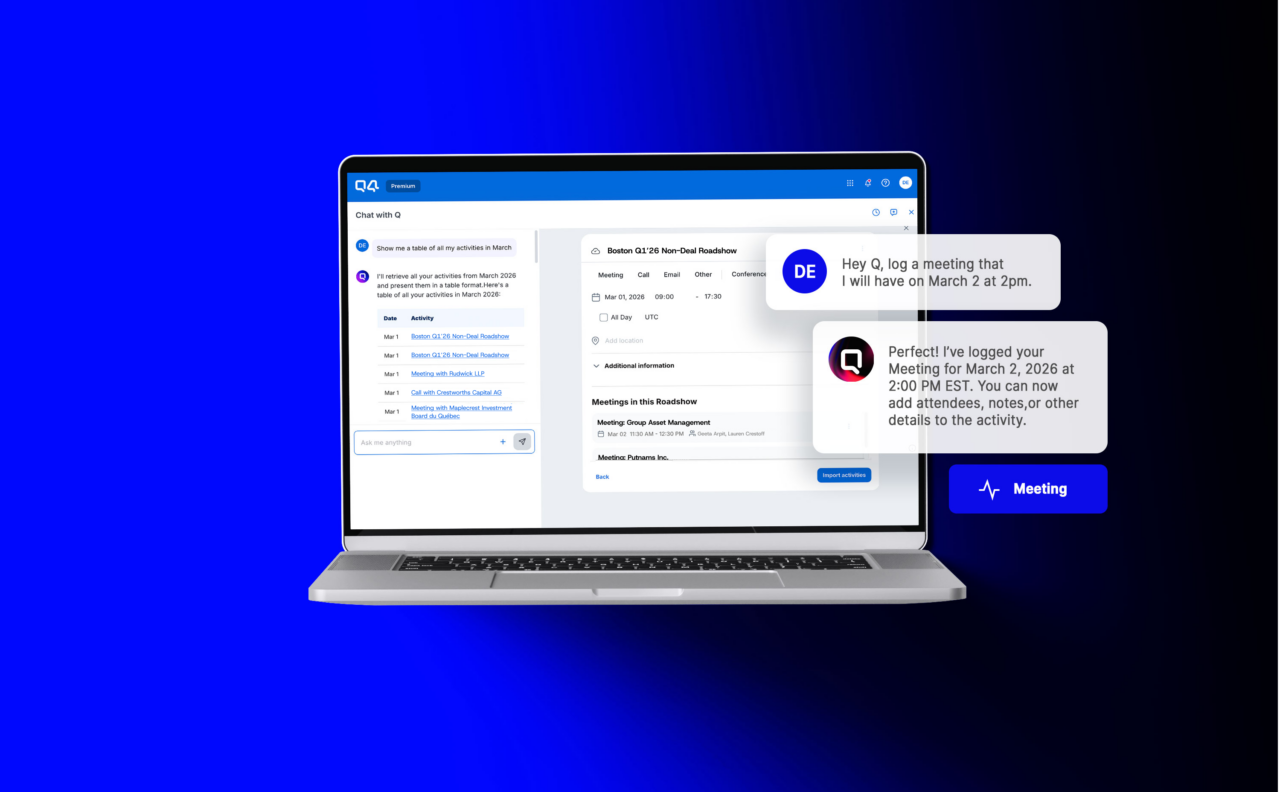
Why Q4’s AI-Native CRM is Different:
- Conversational Data Queries: IROs can literally chat with their CRM. Ask “Which investors attended our last three earnings calls but haven’t increased their position?” or “Summarize this portfolio manager’s position and key takeaways from our last conversation,” and get data-backed, instant answers.
- AI-Powered Activity Capture: Automatically log meetings, parse conference schedules, and structure follow-ups via simple chat entries, file uploads, or a direct Outlook calendar sync.
- Instant Briefing Books: Turn meeting prep into a single prompt. Q4 automatically generates tailored briefing materials so your C-suite walks into every investor meeting completely aligned and informed.
- Integrated Institutional Intelligence: Access and manage a proprietary database of over 1,000,000 contacts and institutions, completely refreshed every quarter, giving you unprecedented visibility into market movements.
- Deep Context & History: A generic contact card isn’t enough. Q4’s AI tracks the broader context of the investing institution, mapping their fund’s shifting investment thesis, past objections, peer holdings, and historical interactions with your brand. When a new analyst or PM takes over an account at an institutional fund, Q4 ensures you don’t lose the thread, allowing you to tailor conversations to that firm’s specific investing style.
Ultimately, the best CRM for investor relations isn’t necessarily one that holds the most data, but one that helps you act on it fastest. By removing friction from data entry and delivering instant, strategic insights, Q4 empowers modern IROs to focus on what truly drives value: building trust and managing relationships.
Ready to see how AI-native CRM capabilities can transform your workflow?