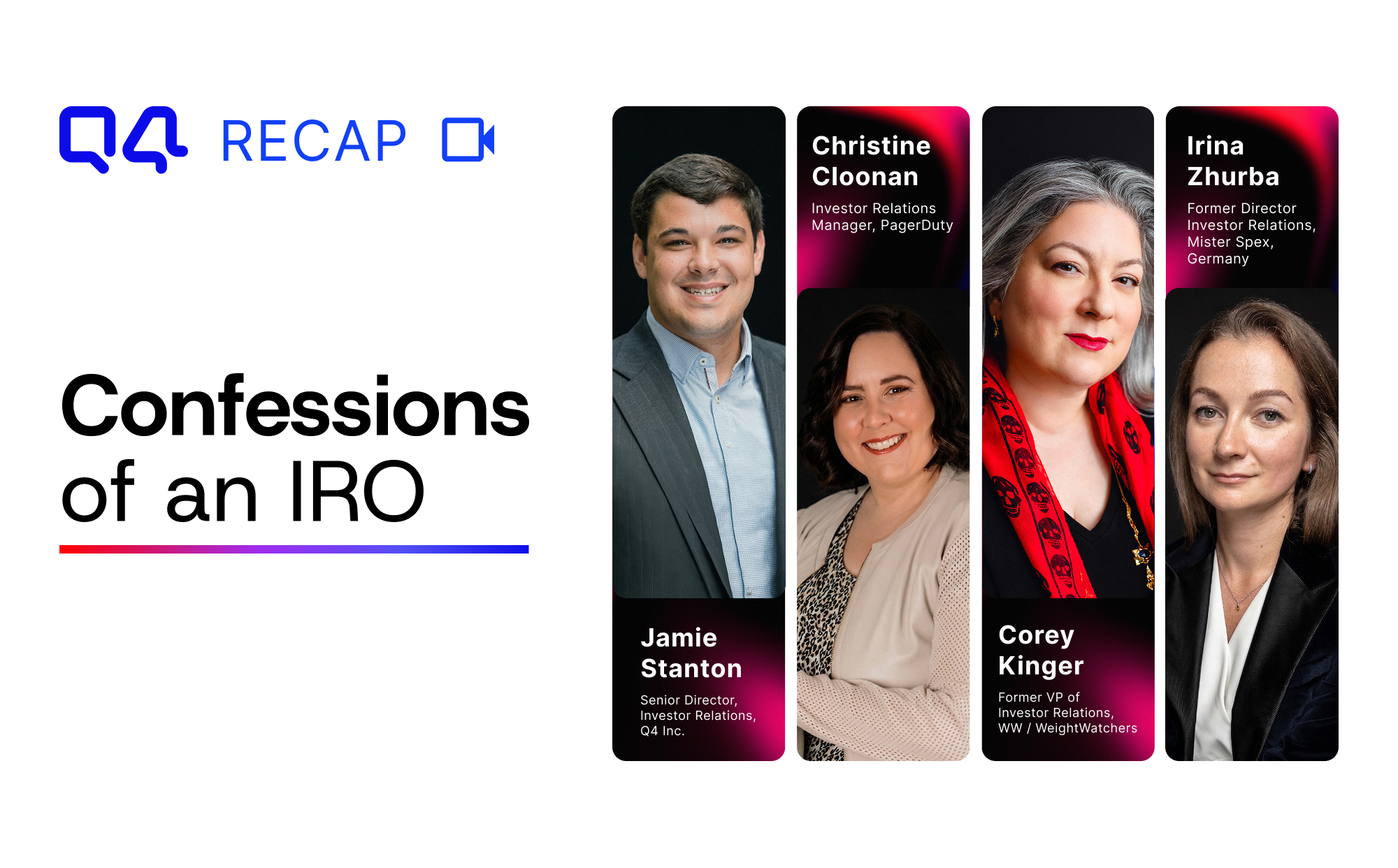
Continue the unfiltered conversation with senior IR leaders from Pfizer, Marriott Vacations Worldwide, and Orthofix at Confessions of an IRO: Episode 2. Register now to join us live.
In the world of investor relations, the public-facing side is all about composure, precision, and the polished delivery of a corporate narrative. But behind the scenes, the reality of being an IRO often involves a far more chaotic landscape. It’s a role that requires you to be a financial analyst, a master communicator, and a logistics expert all at once, often while navigating a mountain of manual work that stays hidden from the C-suite.
We recently hosted a virtual session, “Confessions of an IRO,” where we stepped away from the official talking points to have an honest conversation about what the job really feels like today.
We were joined by three veterans of the field: Corey Kinger, former VP of IR at WW International, Inc., Christine Cloonan, IR Manager at PagerDuty, and Irina Zhurba, Former Director Investor Relations at Mister Spex.
To kick off the session, we asked the audience and panelists a lighter question: “If your IR career were a book or movie genre, what would it be?”
The responses ranged from The Hunger Games to “simply dramatic,” with one attendee describing IR as a “pen & paper adventure / dice-roll game.” Irina Zhurba compared her experience to a remake of The Office called The Optician, inspired by her time in optical retail.
The answers were lighthearted, but they reflected something many IROs are feeling right now: there is no standard playbook for navigating today’s market.
Their scar tissue provided a roadmap for how IROs can move from simply managing a narrative to actually owning the volatility. Here are the core themes that emerged from the trenches.
1. Activism is a “Small-Town Drama” with Long-Term Stakes
When we think of activism, we often imagine sophisticated Hollywood-style attacks. But for those who have lived through it, the reality is much more persistent and in-your-face. Irina Zhurba, who helped her previous company win an award for crisis management, shared a sobering confession: an activist attack isn’t a battle, but rather a multi-year war of attrition.
“If you think the AGM is your battleground, think again. An activist gets in it for the very long term… You might win one AGM, but there is at least a two-to-three-year runway where you still need to be fighting.” — Irina Zhurba
The tactical takeaway: Simplicity sells. Activists often use alternative facts and incredibly simple stories to force valuation dips because simple stories are easier for the broader market to digest. To counter this, IROs must focus less on correcting every minor data point and more on protecting the core narrative with their top 10 investors.
2. Using Website Data as a Strategic Hedge
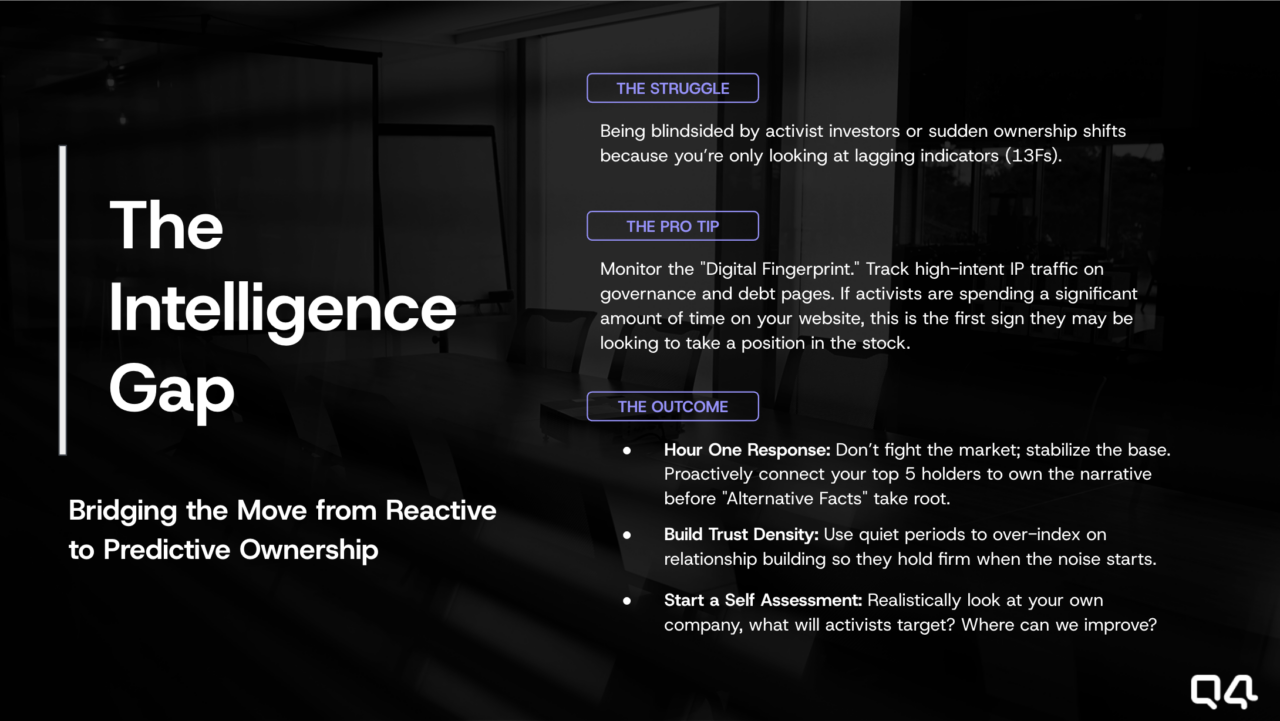
One of the most forward-looking confessions involved the intelligence gap: the space between an activist starting a campaign and the company finding out about it. The panel was bullish on a tool that is often sitting right under our noses: website analytics.
Irina described website data as the holy grail for spotting early warning signs. If a famous law firm specializing in activism suddenly spends 35 minutes on your capital allocation slides at 2 a.m., that isn’t a coincidence.
“You really need to look into how you set up the website… you need to get this incremental piece of information of who is looking, when they’re looking, and what they’re looking at. That will give you so much.” — Irina Zhurba
At Q4, we see this daily. Your digital presence isn’t just a library but more of a sensor. By monitoring which pages are being picked up by bots versus humans, IROs can get a head start of weeks or even months before a formal campaign begins.
3. The “Uncomfortable Room” and the Market Conscience
Being a true thought partner to the C-suite often means being the only person in the room willing to say that a vision might be dead on arrival.
Corey framed this not as a conflict, but as a fundamental duty. While a CEO is often looking five years down the road, the IRO must balance that vision against the expectations of the next four quarters. Bridging that gap requires radical honesty and, perhaps more importantly, an expert sense of timing.
“My job is to look around the corners, to poke holes at it… Often, the intervention is a matter of timing. Can we seed this more, or does this have to happen now? What is the goal? The earlier I’m in the room sharing that perspective, the better.” — Corey Kinger
By shifting the conversation from “the strategy is wrong” to “is the market ready for this today?”, the IRO moves from being a wet blanket to a strategic shield.
4. Navigating the “Frustration Gap”
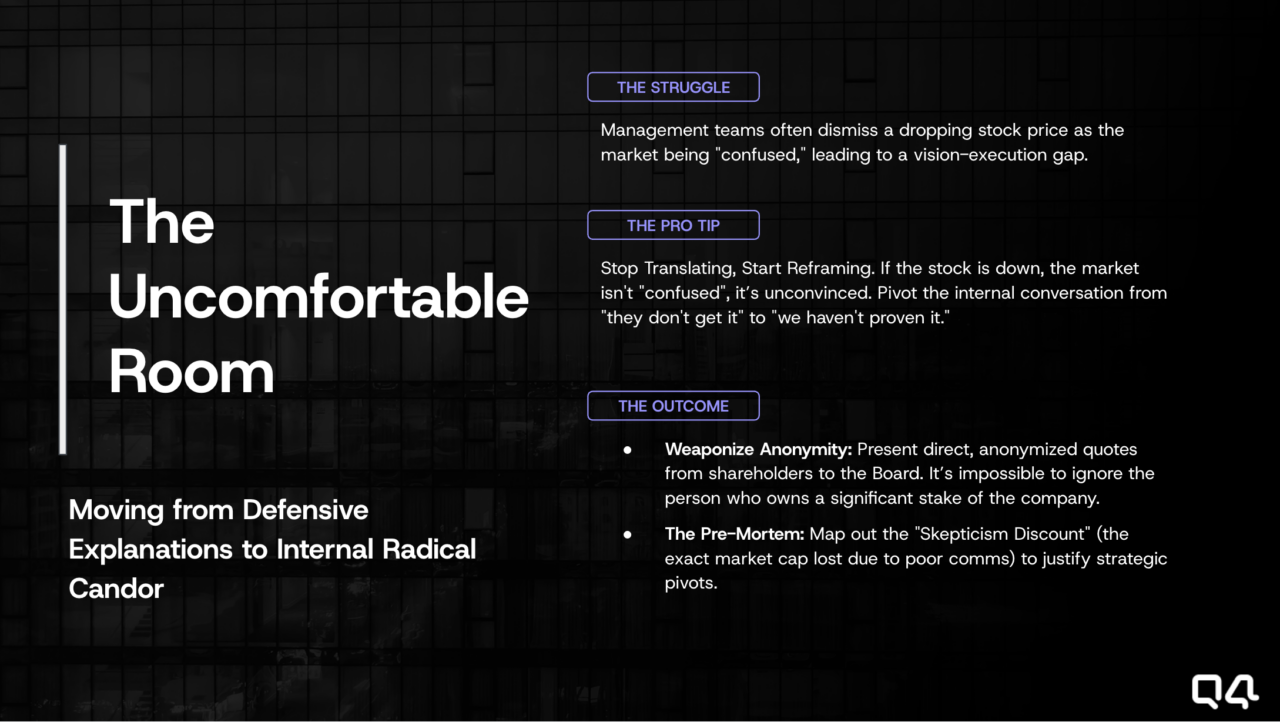
There is a specific type of tension that exists in the C-suite when the stock price doesn’t reflect the internal momentum of the business. Leadership often defaults to a comforting narrative: “The market just doesn’t get it.”
However, the panel challenged this assumption, identifying what we call the Frustration Gap. There is a thin, but very expensive, line between the market being confused and the market being unconvinced. Our poll during the session showed that many IROs struggle when leadership defaults to the idea that the Street is simply “missing the story.”
The panel’s advice was to pivot from frustration to an objective audit. By using third-party perception studies, you can put investor feedback in black-and-white. This tactical move removes the personal filter from the IRO and presents the C-suite with the unvarnished truth of your “Investment NPS.”
As the discussion highlighted, if the gap exists because trust has been broken, there is no silver bullet. It often takes a year and a half to two years of meticulous, “nice and boring” execution to bridge that gap. By providing this realistic timeframe, the IRO shifts from being a messenger of bad news to a strategic partner managing a recovery roadmap.
5. Writing for the Non-Human Audience
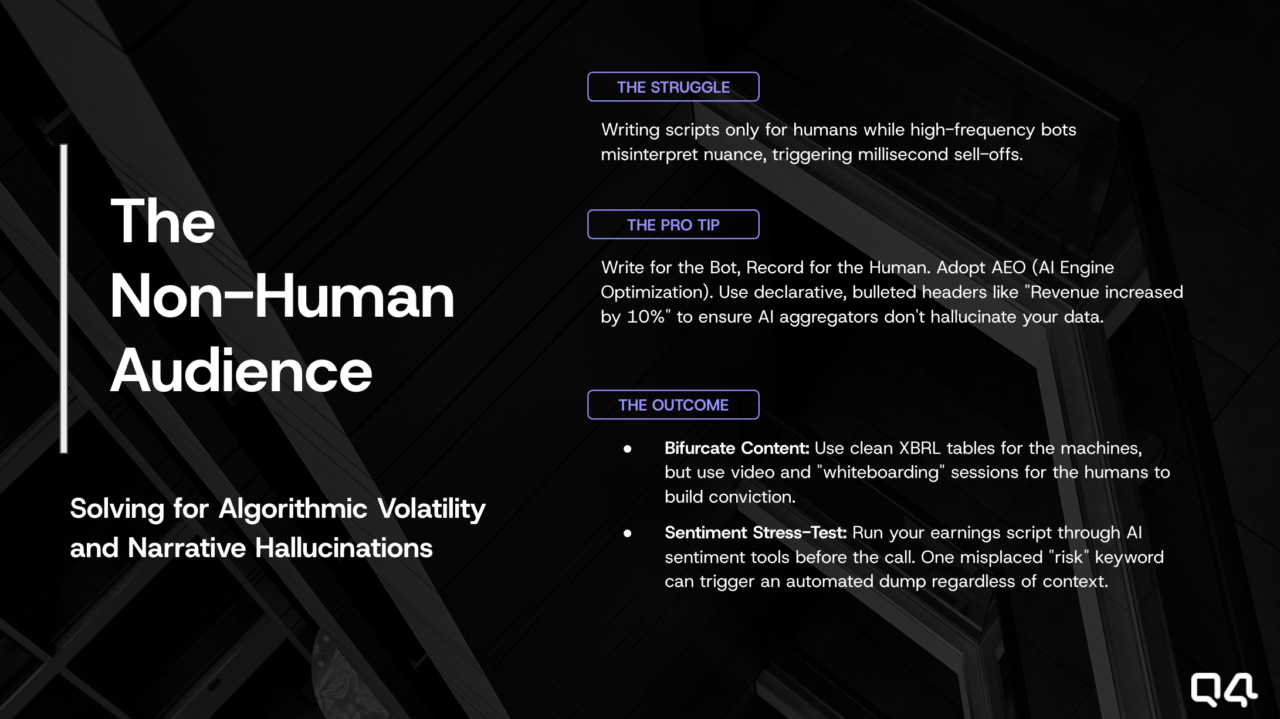
In 2026, we have to acknowledge a secondary audience: the AI scraper. The panel discussed the soul-crushing reality of spending weeks on a script only to have an algorithm misread the sentiment.
The consensus is that IR communications must now be optimized for agentic readability. This means:
- Bullet points over prose: While corp comms might love free-flowing text, AI prefers structure.
- Consistency in “stem words”: If you have a transformation program, use the full name every time so the AI can bucket the data correctly.
- Headline-driven numbers: Much like the old Bloomberg terminal days, the first ten words of a press release now dictate the immediate algorithmic reaction.
“We are now thinking about it as the human and the non-human. It’s really important for you as a professional to better understand how the bot world is thinking.” — Christine Cloonan
6. From Information Requester to Strategic Intelligence Hub
Finally, the panel explored how to move the IR department out of its silo and into its rightful place as a strategic intelligence hub. A common struggle for IROs is feeling like an “information requester”, the person always knocking on doors for data right before a deadline.
The panel suggested flipping this dynamic. Instead of just pulling data out, start pushing insights in. Christine Cloonan emphasized that IR success internally is about being a visible, active participant in the company culture long before you need a favor.
“There’s often a lack of understanding about what IR does. Get out into those departments and speak at onsites or provide a lunch-and-learn. People know why you need the information and how it benefits them in the work they are doing.” — Christine Cloonan
Corey Kinger added that other departments are often hungry for the IRO’s unique perspective. Because IR sits at the intersection of the Board, the C-suite, and the Street, you have a 360-degree view that most internal teams lack.
By sharing market feedback with the product or sales teams, you transform from a cost center into a value add. As the panelists noted, these internal relationships are built during the steady intervals of the year, but they are most useful when it gets loud. When volatility hits, a department that understands your mission will move mountains to get you the data you need.
The Road Ahead: Closing the Credibility Gap
The market of 2026 is defined by its lack of a “standard” playbook. Whether you are navigating a “choosing-your-own-adventure” career like Corey, or managing the high-stakes “Optician” sitcom like Irina, the goal remains the same: Trust.
You build trust with the Board by being the one who looks around corners. You build it with investors by executing on the boring promises every single quarter. And you build it yourself by leveraging tools that handle the algorithmic noise so you can focus on the human story.
As the webinar concluded, the overarching takeaway was that you cannot simply play defense anymore. In a world of weaponized data and non-human audiences, the most successful IROs are those who own the volatility rather than just reacting to it.
Your Tactical Next Steps:
- Audit your digital footprint: Is your website “structured bait” for AI scrapers?
- Normalize the Board update: Don’t wait for a crisis to speak to your directors.
- Move to “Live” Perception: Consider ongoing investor NPS tracking to keep a real-time pulse on the Street.
At Q4, we are committed to being the partner that helps you clear the noise. We believe the future of IR is one where technology handles the repetition, and you handle the relationship.
Ready to lead your program forward? Download the Crisis to Credibility Playbook or watch the full replay of the “Confessions” session to hear the unfiltered truth from the leaders in the trenches.